
Stucco Replacement & Removal in St. George, UT | St. George Elite Stucco
St. George Elite Stucco is a licensed and insured stucco contractor that has worked on residential and commercial properties in St. George, Utah for 15 years. Stucco replacement and removal takes the old finish off the wall and builds it back.
The work covers a whole-house tear-off, one elevation, or a single section of wall, and stucco removal is a scope of its own rather than a step folded into an installation. When patching the same wall keeps bringing you back to it, this is the scope that answers it.
Tear-off to sheathing means the finish, the metal lath under it and the water-resistive barrier behind that all come off together. Sheathing is the wood board your exterior walls are built from, and IRC R703.7 is the residential code section a replacement is built to. Where a house went up before 1992, testing and inspection come first. Containment and disposal get planned around a property you are still living in.
You get a written findings list on the open wall, with photographs, before anything is closed back up. We remove and replace stucco across Washington County, including St. George, Washington and Hurricane. Once your wall is open, it is listed and priced before it is covered, and that is the one thing a closed wall cannot give you.
Request a Free Estimate
We're ready to take on your project!
When a Wall Is Past Repairing
When the finish has stopped doing its job across a broad area instead of failing in isolated spots, your wall has reached the point of stucco replacement. When damage stays within sound plaster, it can usually be handled as a repair, which is a smaller service at a smaller price. The decision comes down to the wall's repair history, how much of the surface has failed, and how much of the house must come off.
The History That Points to Replacement
Repeated patches in the same areas can tell you that the trouble extends beyond the earlier failed patches, especially when those patches are letting go around their edges. When damage runs across a whole elevation, meaning one full face of the building, it points toward replacement as well. Corroded lath or rusted fasteners found the last time someone opened the wall are another sign because the metal underneath holds the plaster in place.
Large, connected areas that sound hollow when tapped also belong on the list, although figuring out why they separated is remediation. When a moisture investigation has already traced the path water followed, correcting that path often leads to replacement because the wall must be open to close it. If you are replacing windows or changing a roofline, the finish must come off whether or not it has failed, making full replacement the resulting scope.
The 30 to 40 Percent Figure, and What It Is Not
Damage covering roughly 30 to 40 percent of a wall area is where owners often begin comparing full replacement with another round of patching. Before you use that figure to decide whether to repair or replace, it helps to understand what the number means. No code publishes it and no standard sets it. It is a rule of thumb that represents two practical considerations.
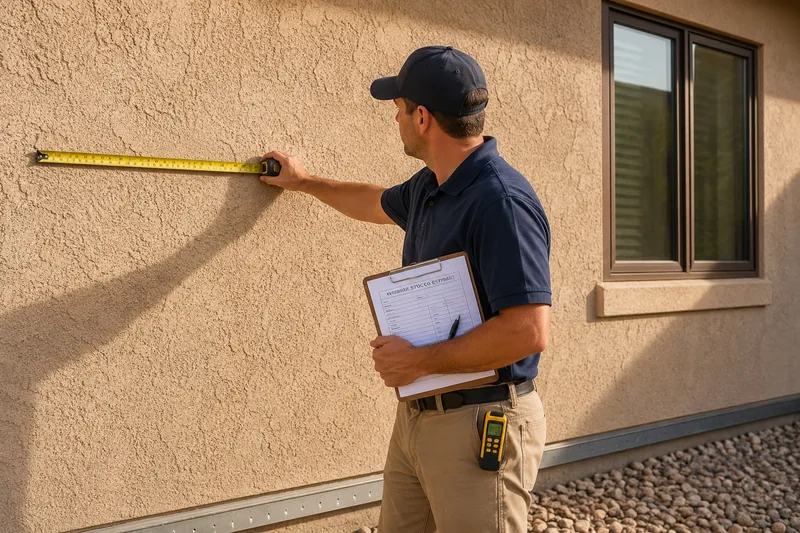
The first consideration is cost. As the patches accumulate, repairing that much wall approaches the cost of rebuilding it, and eventually you may pay for extensive patching before still needing replacement. The second consideration is appearance because a wall face with that many patches will not look even afterward, however carefully the finish is matched. We measure the damaged area on site with a tape and compare it with the elevation where it appears. Treat it as an aid to your decision, never as a rule anyone applies to you.
Whole House, One Elevation, or a Section of Wall
The right size for the job depends on how the damage is distributed across your house. A whole-house tear-off to sheathing usually suits a building whose walls went up together and have aged together. Removing one elevation can make more sense when only the side exposed to afternoon sun or driven rain has failed. The smallest scope is partial removal of one wall section, where a remodel or an already traced water path determines the edges.
To give the replacement a defined stopping point, we cut the line at a corner or at a control joint, the planned break built into the wall, rather than partway across an open face. When a new elevation must blend into the finished wall beside it, that is repair work and belongs with that service.
What Tear-Off to Sheathing Exposes
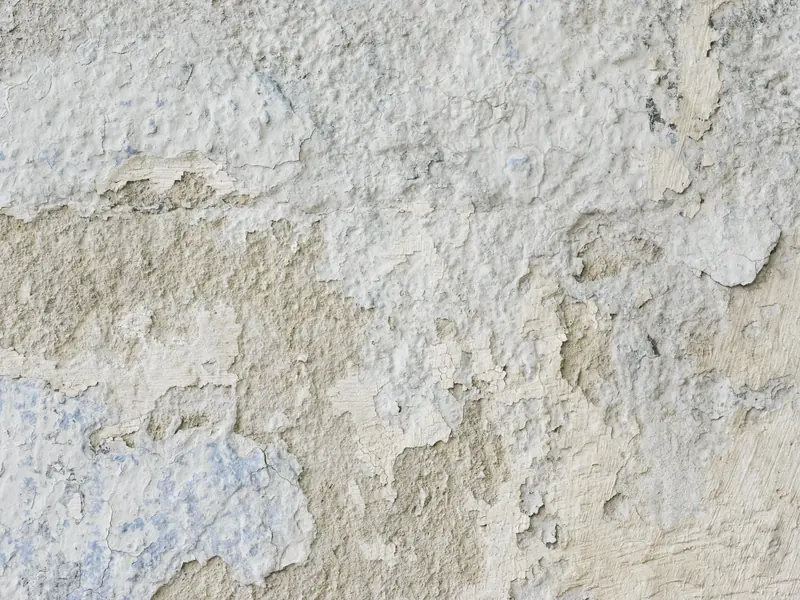
When you need to know what is happening behind the stucco, removing the wall to the board beneath it provides the clearest answer. This is called a tear-off to sheathing, and stucco removal is the one scope that puts the whole wall in front of you. Every other service works on a finish that remains in place and draws conclusions about the substrate behind it. What comes off and what lies underneath are two separate subjects, so an open elevation is your only chance to price the second one from what is actually there rather than from an assumption.
Taking the Finish, the Lath, and the Barrier Off
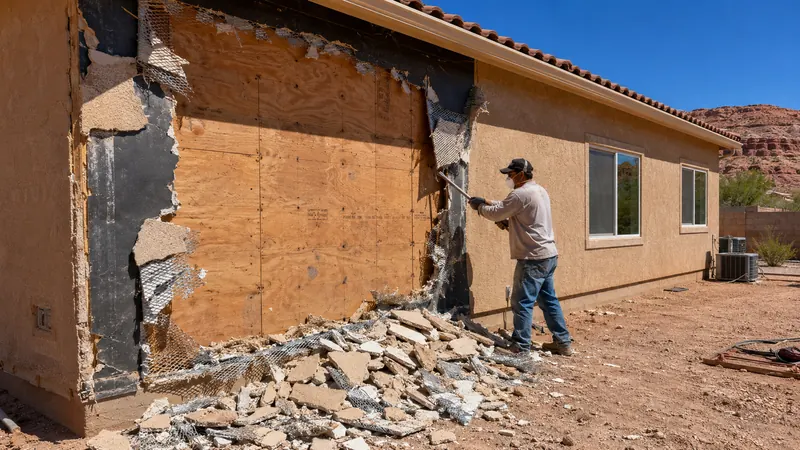
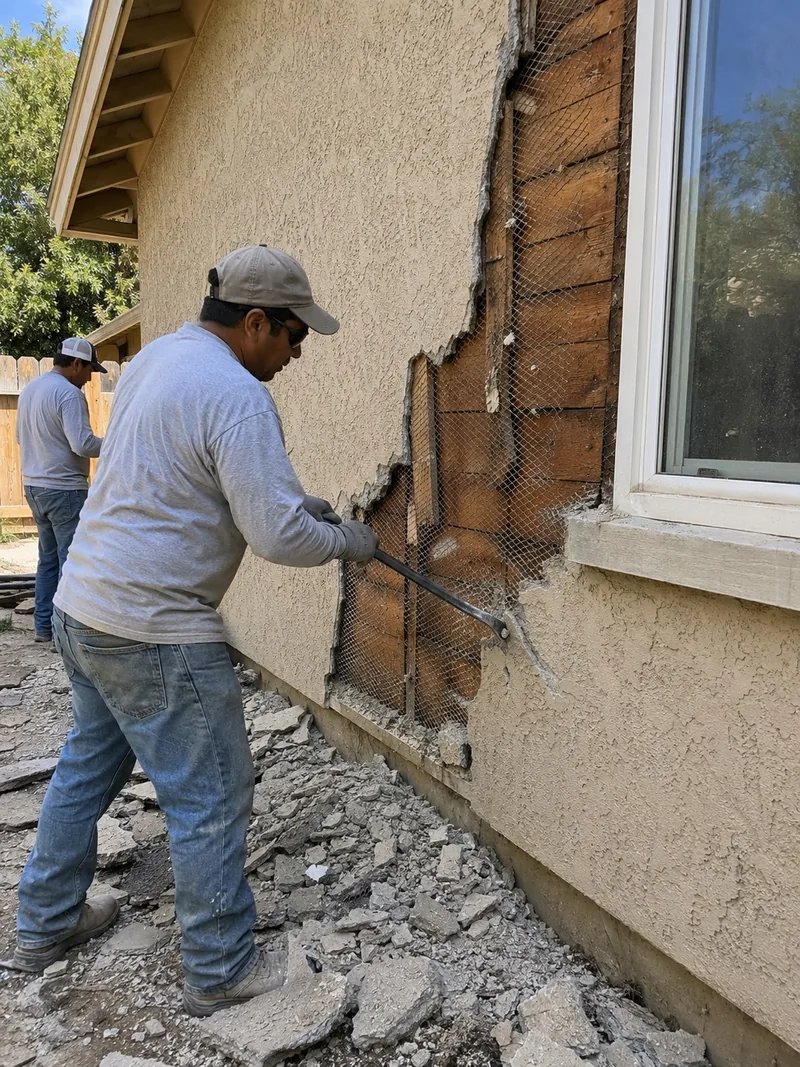
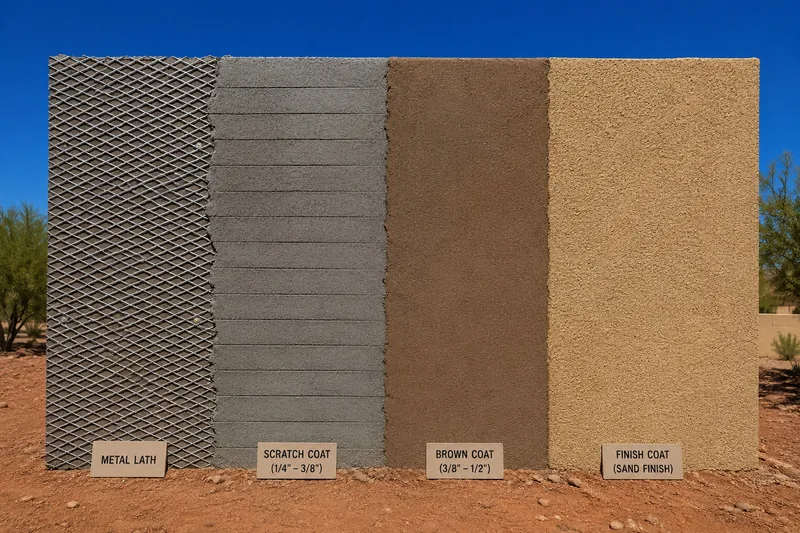
To expose the sheathing, the board beneath the wall layers, everything attached over it must come away. The finish and base coats are keyed into wire mesh, called metal lath, which the plaster grips as it hardens. As a result, the plaster and mesh leave together. The water-resistive barrier underneath also comes off with the lath rather than remaining for whoever rebuilds the wall. We also remove the metal trim along the edges and base, including the weep screed, which is the drainage strip at the foot of the wall.
Your window frames, doors, flashing and pipe penetrations need careful handling while the surrounding wall is being stripped. Fasteners are pulled instead of driven flat so the new lath has clean board to bite into. Since none of the existing material is worth keeping once the wall is open, the sealant around each opening is cut out as well. Power tools handle the open areas, while hand tools are used around every opening so the frames and flashing come through the work intact.
The Findings List You See Before Anything Is Closed Up
Before the wall is covered again, you need a clear record of what the tear-off exposed. Once an elevation is bare, we photograph it and write down what is there, with the date recorded on every file. Most open-wall findings lists include six conditions.
- Soft or rotted sheathing. The condition of the board determines whether it must be replaced and how far the replacement needs to run.
- Dark staining across the board. The staining traces where water traveled and determines how much farther the inspection opens the wall.
- Fastening that missed the framing. If the old lath was attached only to the sheathing, the new lath goes back differently.
- Corroded lath and rusted fastening. The corrosion shows how long water sat in that part of the wall.
- Flashing missing, or lapped the wrong way. This condition commonly appears at window heads and roof-to-wall lines.
- Framing that has moved. If the framing has moved, a separate trade handles that work, and we identify it rather than plastering over it.
Every finding on your list is priced as a change to the written scope, and you approve the change before we continue. Determining where water entered the wall in the first place requires a moisture investigation, which belongs to our remediation service rather than this one.
Planning a Stucco Replacement & Removal Around an Occupied House
Living in a house during stucco removal means the work has to be planned around how you use the property each day. Because stucco removal is demolition, containment goes up before the wall comes apart. From there, the plan has to answer how you will keep using the house while one elevation is open. It also has to address where the old wall will go once it comes off.
Keeping the House Usable While an Elevation Is Open
Falling plaster creates dust and heavy rubble, so the areas beside the working wall need protection before demolition begins. We put down ground cover and hang sheeting beneath the working face before we touch the stucco. Before the first cut, the windows, vents and air conditioning condenser on that side are closed or covered for the day. Your walkways, doors, meters and hose bibs stay reachable throughout the job so you are not working around blocked access for weeks. We open one elevation at a time rather than opening the house all around, and our crews are on site Monday to Friday, 8 am to 6 pm.
Debris, Weight, and Where the Material Goes
Where the old wall goes, and where its container stands, affect how demolition fits around your occupied house. A container of stucco reaches its weight limit long before it looks full, so swaps are scheduled into the job instead of being called for on the day. Plaster and lath leave as construction and demolition waste. When enough lath can be pulled clean, sorting it for a metal recycler is worthwhile. Anything a laboratory has flagged leaves that disposal stream entirely and is handled under its own rules. You choose where the container stands, and we protect the ground beneath it before it arrives.
Asbestos and Lead Testing Before Tear-Off
Before tear-off, we arrange laboratory testing for lead in older coatings on a home built before 1978, and Utah requires an asbestos inspection by a certified inspector on a home built before 1992. The removal work triggers the testing, because chipping a painted wall off the building can create an exposure that does not exist while the wall remains undisturbed. The testing we arrange before work begins gives you a laboratory result instead of leaving that question unanswered during demolition.
What Gets Sampled Before the Wall Comes Off
On an older house you cannot tell by looking at a wall whether it contains asbestos or lead, so experience alone cannot provide the answer. Asbestos and lead testing includes samples from the finish and its coatings, along with adjacent materials such as the sealant around openings and the glazing compound at older windows. Because the samples must be collected while your wall is still intact, the laboratory testing has to happen before the tear-off crew begins.
How a Positive Result Affects the Work
If an asbestos sample comes back positive, taking that material off is a licensed abatement scope and it is not ours. We are stucco contractors, and this is one of the places we hand the work to somebody else. When lead is found on housing built before 1978, the tear-off remains a renovation rather than becoming an abatement project. If the work disturbs more than 20 square feet of exterior painted surface, the firm performing it must be certified for lead-safe work under the applicable renovation rules. Before the wall comes off, ask any contractor you are considering, including us, to show you that certification.
Why Choose St. George Elite Stucco for Stucco Replacement & Removal
Before a new finish covers the wall, you should know what was found underneath and how the removal will affect the property. While the wall is open, we document its condition, and we plan the removal before work starts so the crew is not improvising around an occupied building. St. George Elite Stucco handles residential and commercial walls across the county, whether the job involves one section or a much larger replacement.
You See the Wall Before It Is Closed
Once an elevation is open, you have a brief opportunity to see parts of the wall that nobody has been able to inspect since the building was constructed. Every open elevation receives an inspection and a photograph, with the date recorded on the file. The open-wall findings list attached to those photographs covers the substrate, the fastening and the flashing, rather than only the plaster that came off. The list also becomes part of your written scope. You keep the photographs whether or not any finding turns into approved work. One section of wall is a normal job for us, and it is worth a call.
Licensing and Coverage You Can Verify
A tear-off involves demolition on your property, so you should verify that we are licensed and insured before the first morning of work. Before we work on your wall, you can verify our license and insurance coverage. We carry general liability and workers' compensation. Certificates are available before work starts, and our license number goes on every written estimate. Ask for the certificate when you book the inspection rather than waiting until the crew is outside. Call (435) 236-2699 or use our quote form to schedule a free on-site estimate.
What Makes a Replacement Cost More or Less
Until the wall is opened, one of the biggest factors affecting your stucco replacement cost remains hidden behind the finish. A replacement combines two jobs in one price: taking the wall off and then building it back. Most of the variation comes from the removal work, with seven factors accounting for the spread.
- How much wall is coming off. Your removal cost is based on each elevation rather than the size of the damaged area, because the crew must set up for the whole face instead of a patch.
- Story height and access. When an upper elevation needs staging beneath it, that staging is priced whether the wall face is large or small.
- What the open wall turns up. Because nobody has seen the sheathing, its condition cannot be priced in advance. The estimate therefore includes a contingency, and any finding is handled as a priced change.
- Whether you are living there. The containment on an occupied house takes more work than the same tear-off on an empty property.
- What the disposal takes. Container swaps and hauling distance appear as their own line on your estimate, and a heavier elevation requires more of both.
- Testing and inspection on an older home. If asbestos and lead testing produces a positive result, the job gains an abatement contractor's scope, which that contractor prices rather than us.
- The system that goes back on. The rebuild portion is priced with our installation work, and most of your choices affect that half of the job.
While your wall is still closed, we will not give you a per-square-foot rate over the phone because the condition that determines the price is still behind the finish. For an on-site inspection, call (435) 236-2699 or use our quote form.
Containment, Removal, Inspection, Rebuild
Knowing what happens next makes a stucco replacement easier to plan around, especially while you are living in the house. St. George Elite Stucco follows the same five-step process whether the work covers one elevation or the whole house, beginning with the first walkthrough and ending after the new finish is reviewed.
-
On-Site Walkthrough and Written Scope.
Before work is priced, we measure each face with you and agree on exactly what is coming off. The visit costs you nothing, and the written estimate keeps the removal and rebuild on separate lines while covering both halves of the job.
-
Arranging Testing, Permits, and Approvals.
The permits, community requirements, and testing may need to be settled before removal can begin. We verify the jurisdiction and handle required permit applications. If your HOA or community reviews exterior work, we provide product color and texture samples for the submittal. On an older home, we also arrange the laboratory testing at this step.
-
The Containment and the Removal.
Before anything comes off the wall, the protection goes up around the work area. We remove one elevation at a time and clear the rubble as we go, so you know which face of the house will be open on any given day.
-
Open-Wall Inspection and Your Sign-Off.
Once the wall is bare, you can see what was hidden behind the finish before the rebuild covers it. We walk the open wall with you and provide the photographs. Anything found waits for your approval, and nothing is closed before that conversation takes place.
-
Rebuild, Final Walkthrough, and Haul-Off.
After the approved inspection, the rebuild moves into our installation work. Once the finish is on, we review every elevation with you. The final cleanup removes the staging, sheeting, and containers as the job closes.
To put a walkthrough on the calendar, call (435) 236-2699 or send the details through our quote form.
Replacing Stucco With a Different Cladding
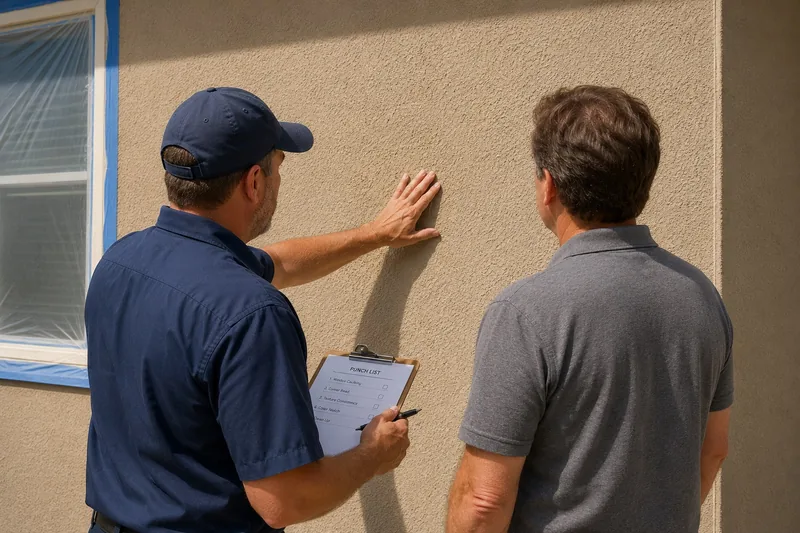
Once a tear-off to sheathing is complete, you are free to choose a different cladding rather than put the same finish back on. The useful distinction is between the removal work that stays the same with every re-clad alternative and the rebuild work that changes with your choice.
What the Tear-Off Does Not Change
Choosing another cladding does not change the removal work already planned for your house. On a re-clad, the removal, the open-wall findings list, and the disposal remain the same whichever cladding follows, along with the crew, containers, and photographs of the bare wall. Fiber-cement siding is a common choice, but we do not install siding, and you are better served by someone who hangs it regularly. Because stone veneer usually covers only part of an elevation, the rest of that face still needs a finish. Once you choose, the rebuild half of your estimate changes, while the removal half stays the same.
What the New Cladding Does Change
Your cladding choice affects the details around openings and wherever two materials meet, so it should be settled before the rebuild is priced. An architectural review in your community can narrow the options before you decide. The thickness of the new cladding changes the reveal at your windows and doors, meaning the shadow line around each opening. When one face has two materials, it also needs a termination where they meet, with responsibility for that detail established from the start. Choosing which stucco system goes back on is an installation decision and remains part of that service.
The Residential Code Behind a Stucco Replacement
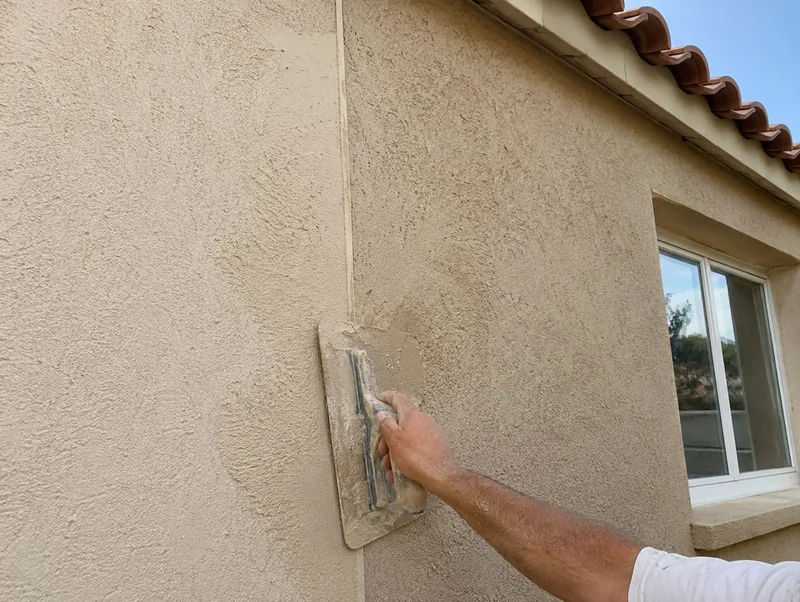
Your old wall and its replacement can follow different requirements, which matters when you compare them. IRC R703.7 is the residential code section that covers exterior plaster, and it is the reference used to build the replacement. Although the old wall met whatever requirements were in force when it went up, the new wall must meet the requirements in force now.
What IRC R703.7 Covers, and Who It Covers
The type of property you own determines whether IRC R703.7 applies. The R in IRC stands for Residential, and the code covers houses, duplexes, and townhouses. A commercial building follows a different code, so R703.7 does not cover a retail block, an office, or a warehouse. Our commercial stucco work is written against that separate code. Within its residential scope, R703.7 governs the requirements that exterior plaster on a dwelling must meet and how it must be applied to the wall. It is the reference we name for a house, rather than for a commercial job.
Permits, Inspection, and a Statewide Code
When you review the schedule for a replacement, the permit and inspection apply to the rebuild rather than the demolition because the paperwork tracks what goes onto the wall, not what comes off. Utah adopts its building codes statewide rather than town by town, and the editions in force are published by the Utah State Legislature (). Contractor licensing is also handled by the state, so one license covers every town in the county.
Stucco Replacement Across Washington County
Spring provides the driest window for open-wall work on your property in Southern Utah. Although St. George receives about 8.8 inches of precipitation in a normal year, localized monsoon storms can be intense, so both summer heat and sudden rain shape the removal schedule while walls are open. Higher in the county, the winters are genuinely cold, which changes the window when your work can take place rather than the way the work is done.
Where St. George Elite Stucco Removes and Replaces Stucco
St. George Elite Stucco serves communities throughout Washington County, from the connected cities around St. George to smaller settlements near the county's valleys and mountain approaches.
- St. George, Washington, Santa Clara, Ivins, Hurricane, La Verkin, Toquerville, and Leeds
- Winchester Hills, Diamond Valley, Dammeron Valley, Veyo, Brookside, Central, and Pine Valley
- Gunlock, Shivwits, Virgin, and Apple Valley
Whether your property is in the valley or the high country, we take removal calls from throughout the service area.

Questions About Removing and Replacing Stucco
Repeated patches and rising repair costs often bring up practical questions about whether stucco replacement has become the less expensive answer.
How is the 30 to 40 percent figure actually used?
When patch costs begin approaching rebuild costs, the 30 to 40 percent figure serves as a decision aid, not a rule. Nobody has written that percentage into a code or specification. The figure is considered per elevation rather than across the entire house, so two faces with 20 percent damage each call for a different decision than one face with 40 percent damage.
What happens if the sheathing turns out to be damaged once the wall is open?
Hidden sheathing damage can affect your final cost, but you see the finding before the wall is covered. Once the damaged board appears on the open-wall findings list with a dated photograph, its replacement is added to your scope as a priced change. The estimate includes a contingency rather than a fixed number because nobody can accurately price a substrate that remains behind the finish.
Can I replace stucco with siding or stone instead?
Choosing siding or stone can change the finished wall, but it does not change the stucco removal that comes first. Once the wall is bare, it can take another cladding. We do not install siding ourselves and will tell you that rather than quote the work. Before choosing a re-clad alternative, settle the thickness because a thicker cladding stands farther from the wall and changes how your windows and doors sit within it.
What gets tested before tear-off on an older house?
Your start date depends on the asbestos and lead testing results, so it helps to book the testing early. Samples from the older coatings and adjacent materials, usually including sealants and glazing compound, go to a laboratory. Taking the wall down is what triggers the testing, rather than the age of the house by itself.
How much does it cost to remove siding and replace it with stucco?
Your price depends on how many elevations are involved, how the crew can reach them, and what turns up underneath the siding. The removal step is much the same whatever is coming off, and removal and rebuild appear as separate work on one estimate. We measure your wall on site because any rate quoted over the phone would be a guess.
Do we have to move out while the stucco comes off?
You usually do not have to move out while the stucco comes off. Only one face is open at a time, and your access stays clear. There will be dust and noise beside the wall being worked, and the windows on that side stay shut for the day. We make no promise about total duration. Where a test comes back positive, the abatement scope runs first.
Find Out What Is Behind Your Wall
Another patch may cost less now, but choosing it over a stucco replacement depends on what is happening behind the finish. We come out to measure the elevations and put in writing which scope your wall actually falls into. Send any photographs you have already taken through the form so we can review them before or during the visit. You receive the estimate in writing, and the visit is free. Call (435) 236-2699 or request a free estimate through our quote form.